
Live Oak County Arrest News Sources
One news source stands out for this area: KRIS 6's Live Oak County page. The outlet groups its coverage by event rather than by booking date. Stories there touch on George West, Three Rivers, county roads, the Sheriff, DPS, and other agencies. It is not a daily booking bulletin. It is not a roster. And it is not an official case database. Photographs used in its stories may come from scene images, video stills, or agency handouts, so treat any picture's origin with care before calling it a mugshot.
No verified daily booking blotter turned up among local newspapers or city sites here. The Sheriff and the two municipal police departments do not publish a recurring official photo feed either. That gap is simply a local fact. It does not mean the agencies keep no internal records.
Where Live Oak County Mugshots Appear
Start with official channels when you need answers. The Sheriff's page lists contact information and points to VINELink for custody status. Need a booking detail or a possible photograph? The Sheriff's Office and the jail are the documented route. City police departments can hold incident reports. Felony filings and case outcomes begin with the District Clerk. None of these official sources offers a public Live Oak mugshot gallery or a live booking feed.
| Outlet or channel | Coverage | Photo or status meaning | Where to use it |
|---|---|---|---|
| Live Oak County Sheriff | Official local law-enforcement contact | No public roster or photo policy found | Custody and records routing |
| VINELink | Participating custody information | Status check, not a photo archive | Current-custody question |
| District Clerk | Felony court filings | Disposition route, not present custody | What happened after booking |
| KRIS 6 | Event-driven county reporting | May include scene media, not a routine booking photo | News context and agency attribution |
| Historical newspaper archive | Past local issues | Historic references, never present custody | Historical research only |
A few third-party sites carry Live Oak-looking pages, including Mugshots.com, Texas Jail Roster, and County Jail Roster. These are outside publications. They do not confirm current custody, release, or how a case ended. Verify whatever details they claim against an official source. The county, the arresting agency, or the court always comes first.
Live Oak Stories and Official Records
A story can outlive the facts behind it. That is why a clear path from news item to official record matters. Pull the date, the named agency, and the incident location from the story first. Next, ask the agency or the Sheriff's jail for a status check or a narrow record. Then let the court file tell you how the case resolved. One caution applies to rosters. A missing entry can mean the person was released, or that indexing lagged. It does not prove no booking ever happened.
- Read the story for its date, reporting agency, and whether it says an arrest, booking, or court action occurred.
- For current local custody, use the Sheriff’s VINELink route or contact the Sheriff/Jail.
- For a past booking, request existing booking-in, booking-out, release, transfer, and photo material from the records custodian.
- For felony filings, use the District Clerk; for lower-level matters, identify the relevant court or precinct.
- Record the source and date checked. Do not infer a conviction from an article or a booking charge.
News stories about Live Oak County arrests spread fast. Official county records are the steadier source.
Countywide custody and records details sit on the Live Oak booking records page. The city routes differ a bit. George West policing runs through a Sheriff-dispatched structure. Three Rivers, by contrast, offers a documented written-request path for records.
Why Live Oak Booking Photos Are Limited
Texas Government Code Chapter 552 governs requests for public information that already exists, and the agency itself must review the actual record. Basic arrest details can be handled differently from investigative material. Still, no county policy promises that every booking photograph will be released. A single photo can run into privacy, juvenile, medical, security, or confidential law-enforcement restrictions.
A second law, Texas Business and Commerce Code Chapter 109, covers accuracy, corrections, fees, and notice after an expunction or nondisclosure order for certain criminal-record publishers. It does not force the Sheriff to post photos. When a story runs with a picture, ask where it came from. A reporter's scene shot, an agency handout, and a jail booking photo are three different things. One should never be swapped for another.
Live Oak County News After Booking
The courthouse is where an early news item grows up. The District Clerk's official page lists district-court criminal filings and a way to make contact. Remember that a booking can come before any prosecutor filing. Court paperwork may also use a different spelling, cause number, or offense wording than the news did. An entry reading "no disposition found" just means no result turned up in that one source.
The County Clerk's online search covers public and real-property records, not a confirmed criminal docket. For lower-level matters, the justice-of-the-peace offices matter. Later custody runs through separate systems: TDCJ, the BOP, and ICE. And note that FCI Three Rivers is a federal facility, not the county jail.
Live Oak County Historical Arrest Coverage
History buffs have two good starting points: the Live Oak County newspaper archive and the TXGenWeb local newspaper index. Old court, jail, sheriff, and community references often surface there. These are research aids, not custody tools. An old newspaper image should never be reused as a current booking photo.
For older agency or court files, ask the records custodian first. Find out whether the material was retained, transferred, or destroyed under the state retention schedule. The State Library's local-records and convict-ledger collections can help with deep historical work. Still, a later official record beats a historical news item every time.
For a live example of event-driven reporting in this area, the KRIS 6 county news hub is worth a look.
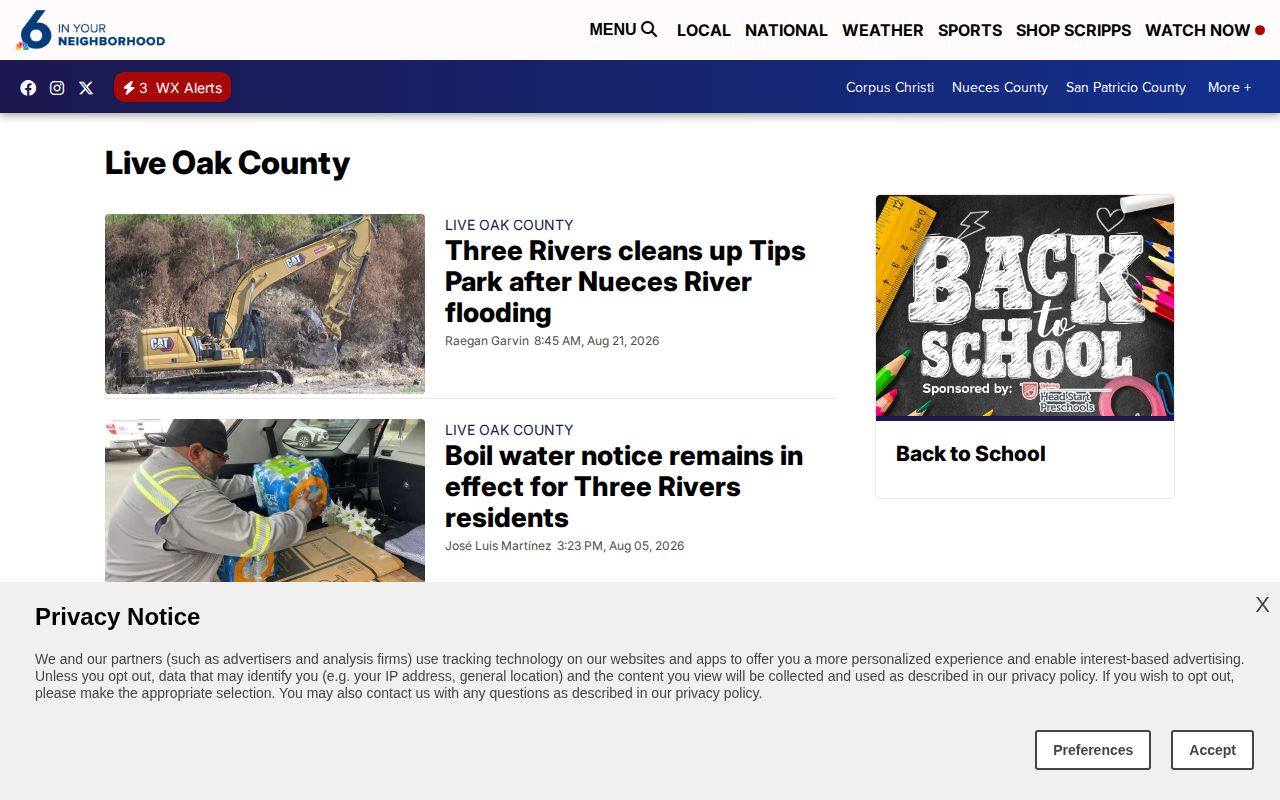
Keep in mind what this page is not. The screen shows a local-news landing page. It is not a jail roster, not a booking record, and not the place to find a person's final court disposition.
Live Oak County News Limits
Live Oak County has no reliable daily booking blotter right now. Nothing from a county newspaper, city page, or official source publishes arrests on a set schedule. No named agency stands behind one, the update rhythm never holds steady, and there is no way to correct errors. KRIS 6 covers events as they happen rather than keeping a running arrest ledger. The older archive of stories still has value, but only for history. It cannot confirm whether someone is booked, out, or through the courts today.
Third-party pages wearing a Live Oak label deserve skepticism. Treat the Sheriff, the arresting agency, and the court as the real authorities. A dated story or a photo on one of those sites proves nothing about present custody or how a case ended. Match the article to the agency it names, the incident date, and the court file. Then write down when each official source gave you its answer.
| News or record label | What it can support |
|---|---|
| Agency statement in a news story | Reported event context and the agency attributed by the outlet. |
| Booking or custody record | An intake or custody status at the stated source date. |
| Court filing or disposition | A documented stage or outcome when confirmed by the proper court. |
| Historic newspaper item | Historical research lead, not current custody or a booking photo. |
Note: A news image, a scene photograph, and a booking photo are different records and should keep their original source labels.
Live Oak County News Record Checks
Start with what the news outlet itself gives you: the date, the agency named, and the place identified. Be careful here. A story set on a county road, in George West, or in Three Rivers does not settle which jurisdiction applies. Ask the arresting agency directly for the incident record. For booking or custody questions, go to the Sheriff or the Jail. From there, pick the court route that fits the case type to find a documented disposition.
Good notes separate the stages: reported, arrested, booked, in custody, released, transferred, and disposed. Those are not the same thing. Someone can be booked and walk out before any story runs. A prosecutor might file charges weeks later. The eventual court result can look nothing like the first agency statement. So keep the source date and the supplying office attached to every fact you record.
- Reported
- Describes what an outlet attributes to an agency or another source.
- Booked
- Describes jail intake, not a lasting custody status or court outcome.
- In custody
- Requires a current official status source and a time checked.
- Disposition
- Requires a court record, not a headline, image, or third-party status label.
A local story makes a decent first lead. It never replaces the official record chain that follows it.