
Live Oak County Busted Mugshots
A mugshot is taken when a person is booked into jail. That is all it shows. Live Oak County runs no public photo gallery, and no policy here forces every booking image online. The material lives with the Sheriff's Office and the Live Oak County Jail, since jail processing creates it in the first place. Texas public-information rules apply. Still, the agency reviews each record by hand, and an exception or restriction can block release of a photo.
Where you look depends on what you want. An incident report sits with the arresting agency. Booking paperwork sits with the jail. The court file sits with the clerk. Someone released days ago may vanish from a current status lookup even though the booking record still exists. Custody at the state or federal level is a separate question entirely. Write down the source and date with every answer you get, and never treat an old photo as proof of where a person is now.
Charges listed at booking are not final. Courts can reduce them, dismiss them, or resolve them another way, so check the official court record before drawing any conclusion.
Live Oak County Busted Roster Gap
Live Oak County has no verified public booking roster, no booking-photo index, and no same-day arrest feed on its official site. The Sheriff's page instead directs custody questions to VINELink and posts contact information. This is a real limit worth understanding. An agency can keep booking records internally without ever placing a public copy on the web.
For a current question, go through the Sheriff's official route and note the date and source of whatever you find. For a past event, name the person, the approximate booking date, and the arresting agency in a narrow request. A third-party page, an undated image, or a blank VINELink result proves nothing about current custody or a court outcome.
Note: No official Live Oak County roster fields, update schedule, photo display rule, or online archive behavior has been published.
Live Oak County Booking Record Fields
Live Oak County posts no public booking-entry screen. There is no official display to describe. What you can do is request specific items by name. The DPS reporting plan identifies electronic fingerprints, a tracking reference number, booking documentation, magistrate material, jail folders, and transmissions to the prosecutor or court. Give the custodian a narrow date range plus the arresting agency. That helps them find the right file fast.
| Field or document | What it can establish |
|---|---|
| Name and identifying details | Which person and record the agency matched, subject to lawful restrictions. |
| Arrest and booking date or time | When the reported event and jail intake occurred, if maintained. |
| Arresting agency and TRN | Which agency began the case and the DPS tracking reference. |
| Charge wording and bond | The charge as recorded at booking and any public bond information, not a disposition. |
| Booking, release, or transfer record | Whether a specified intake, release, or transfer record exists for the requested period. |
| Photo and court cause number | A photo if maintained and releasable, plus a court identifier if available. |
Keep these labels straight, because mixing them causes real confusion. "Booked" refers only to jail intake. "In custody" requires a current status source, "released" requires a release record, and "sentenced" requires a court or correctional document. Juvenile, sealed, nondisclosed, expunged, and protected-victim material is a different category altogether. Treat none of it as ordinary public content.
Live Oak County Booking Paper Trail
The county's DPS reporting plan shows why one search rarely settles everything. When a reportable arrest enters the Live Oak County process, the jail electronically fingerprints the arrestee and creates a TRN. The plan also names CR-43 and CR-44 paperwork, magistrate warnings, probable-cause affidavits, jail folders, and later transmissions to prosecutors and courts. Related records end up scattered across more than one office along the way.
Each document answers a different question. A police report describes the reported incident. A booking file covers jail processing. A court file takes over once a case reaches the judge. Ask for each by its name. No office has to invent a narrative or reach a legal conclusion for you. That also guards against a common mistake: reading an arrest record as though it settled the case.
- Booking
- Jail intake and the records created during that process.
- TRN
- A tracking reference number used in the DPS criminal-history workflow.
- Bond
- A court-set condition for release, not a statement about guilt.
- Disposition
- The court’s documented result, such as dismissal, plea, acquittal, or another outcome.
Request Live Oak County Booking Records
Texas Government Code Chapter 552 is the public-information route for existing jail and police records. Start with the Live Oak County Sheriff's Office, at 200 Larry R. Busby Drive, George West, Texas 78022. The phone number is 361-449-2271. County expunction material also lists locjaillog@loctx.org for the jail and asheriff@loctx.org for the Sheriff. Mailboxes change. Confirm an address is current, or ask for the records custodian if you are unsure where a request belongs.
- Identify the person, approximate date range, arresting agency, and requested record type.
- Ask for existing booking-in, booking-out, release or transfer records, charges as written, and a booking photograph if maintained and releasable.
- Request electronic copies when available, and ask for a cost estimate before agreeing to a larger charge.
- If an item is withheld, ask the agency to identify the exception or other legal basis for the response.
The Attorney General's public-information request guidance sets two basic rules. Requests must be written, and they must reasonably describe the material that exists. No published fee schedule covers jail photographs in Live Oak County. Do not assume the County Clerk's ordinary copy charges apply to jail records, because they do not set that fee. An older county notice lists 361-449-8041 for the jail, but verify any number before relying on it.
Once a request lands, the agency must promptly produce available public information, certify when it will be ready, or explain why it is not available. The ten-business-day period people often mention concerns asking the Attorney General for a withholding decision. It does not promise a complete booking file within that window. Clarification, redaction, third-party notice, storage location, and request scope can all stretch the timeline.
Note: The public-information response framework guarantees no delivery date for a complete file.
Texas Law and Busted Record Corrections
Texas keeps an eye on how criminal-record data gets published. Under Business and Commerce Code Chapter 109, passed as SB 1289, covered publishers must handle accuracy, corrections, fees, and notices after an expunction or nondisclosure order. The law has limits, though. It does not force Live Oak County to post a roster or release any photo. What it does offer is a practical path: fix a factual error at the source record first, then send a private correction request to the publisher.
Clearing a record takes a court order, and Texas offers two routes. Chapter 55 of the Code of Criminal Procedure governs expunction, while Government Code Chapter 411 covers nondisclosure. The Live Oak County District Clerk posts local instructions plus the list of agencies that must be noticed. Whether a case qualifies turns on the charge, the outcome, the dates, and other facts. Once an order issues, take it to each agency and publisher named in the record; search results then refresh after the source changes.
Be wary of third-party sites. Mugshots.com, Texas Jail Roster, and County Jail Roster all carry Live Oak pages that look official. They are not county systems. Their dates, fields, and status claims deserve an official check, and an old third-party image never means someone is still in jail. Never pay an unverified outfit that promises to alter a public record.
Find Live Oak County Busted Arrest Records
Skip the mugshot hunt and start at the Sheriff's page. It points to VINELink, which can answer a current custody-status question where data is available. Need a specific status or a historical booking record? Call the Sheriff or the Jail directly. Keep expectations realistic. A no-result from VINELink does not mean a person was never booked, since spelling, participating data, timing, release, and retention can all affect what comes back.
- Check the Sheriff’s official page and its custody-status routing.
- For current local custody, ask the Sheriff to route the request to the jail or records custodian.
- For a prior booking or possible photo, make the targeted Chapter 552 request described above.
- For a felony filing or disposition, contact the District Clerk; use the relevant lower, county, or municipal court for other matters.
- Use TDCJ, BOP, or ICE only when the custody state makes that separate system relevant.
Live Oak County has no same-day feed. There is no multi-day booking index, no roster search, and no official gallery of booking photos. Read that absence narrowly. The county may hold internal data, yet no public web endpoint exists. A written records request remains the documented local route to anything.
Live Oak County Busted Custody Status
One useful stop is VINELink, which the Sheriff's site links to. Think of it as a status check, not a booking archive. When participating agencies feed it data, you can learn whether someone is currently held in custody. It won't show booking photos, court dockets, or a Live Oak arrest history. The Sheriff page also lists no mobile app, text alert, or social feed that posts every new booking image.
Read a result with care. A lookup answers one question at the moment you ask it: is this person in custody right now? It can't tell you when a release happened months ago or how a case ended. Released people may drop from the system even though the agency still keeps a booking record. When a search comes up empty, call the Sheriff's main line or file a narrow records request.
The VINELink custody-status page appears here because the county Sheriff links to it as the official public route.
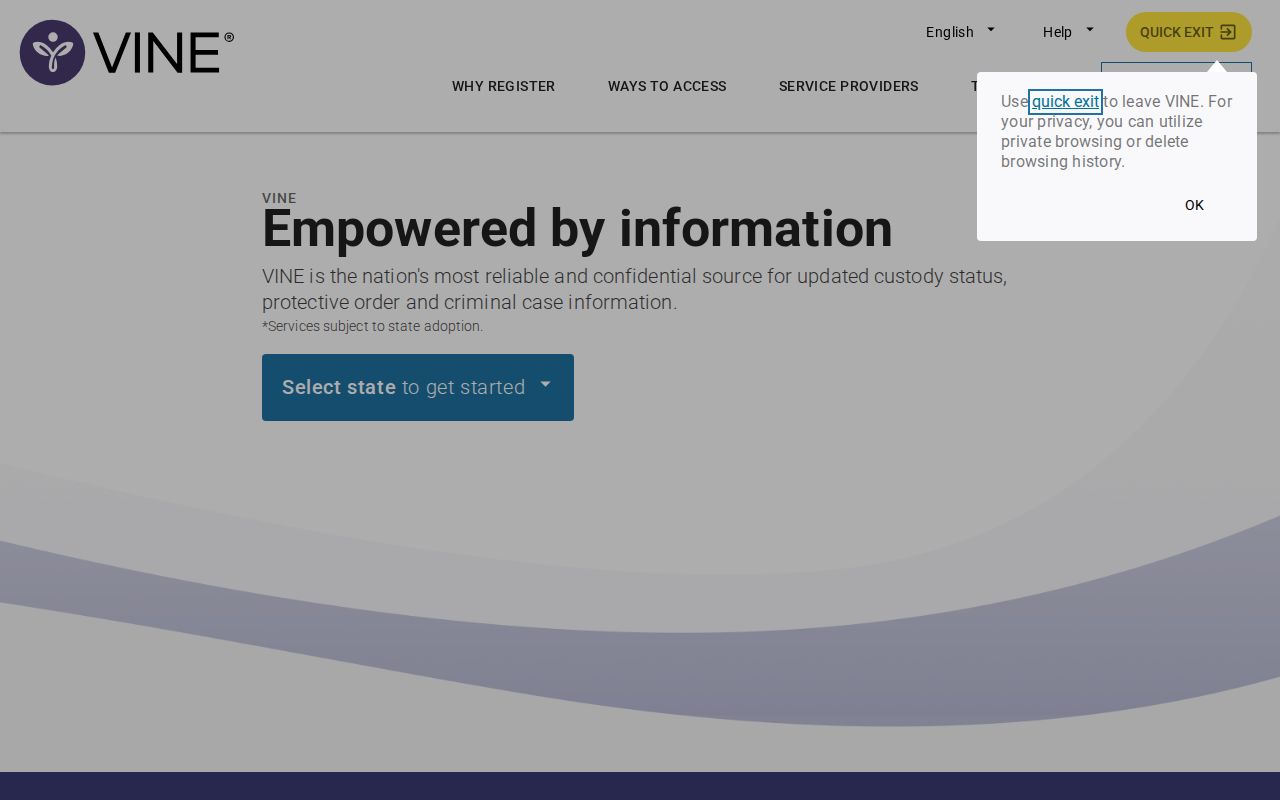
What the screen shows is a status-lookup interface. It is not a Live Oak County roster and not a list of booking photos.
Recent Live Oak County Busted Bookings
No official same-day booking feed exists. Neither the Sheriff, county, nor city police sites offer a recent-bookings page. There is also no published update cadence, entry-persistence rule, search fields, or photo policy for a public Live Oak roster. So don't guess a web address or lean on a third-party page in place of an official feed.
Ask for booking-in and booking-out records separately when you request a date range. That gives the custodian a clear task. It also separates an intake event from current detention or a later release. Weekend timing, lag, and retention have no published online policy here. A future official roster could drop an entry at release while the underlying record stays on file under a retention category.
| Question | Documented route |
|---|---|
| Current county custody | Sheriff/VINELink, then direct jail or records routing. |
| Just-booked or recent record | No public feed located; request a date range from the Sheriff/Jail. |
| Released or transferred | Ask for the booking-out, release, or transfer record. |
| Historical court outcome | District Clerk for felony matters, or the appropriate lower court. |
Live Oak County Busted Record Timelines
Why do pieces of one Live Oak County arrest live on different clocks? The state retention schedule explains it. That schedule sets minimums for local-government records. It is not a live inventory and not an online-posting rule. A roster entry can vanish at release while the booking or court material stays with its custodian. Video may sit in a much shorter retention category than an arrest report.
| Record category | Schedule context |
|---|---|
| Activity log or docket | Generally two years, subject to the schedule’s historical-value review. |
| Arrest report or fingerprint | Six months for certain fine-only matters, and up to 75 years or until death sooner for other offenses. |
| Bail-bond record | Generally three years after the last entry. |
| Prisoner-incarceration record | Release or transfer plus two years. |
| Prisoner video or audio | Thirty days. |
Note: these categories do not prove that a particular booking photo is public or still held, so ask the Sheriff's records custodian how the image is classified, whether it was transferred or destroyed under an approved schedule, and whether a court order changes the answer.
Live Oak County Booking Record Retention
The Texas State Library and Archives Commission Schedule PS sorts records into distinct types. Arrest reports and fingerprints each get a category. So do bail-bond records, prisoner-incarceration material, transfer copies, and prisoner video or audio. These are minimum retention rules. They do not promise that any given image or file is available online.
Take one example. Prisoner-incarceration records cover booking-in and booking-out, personal classification data, and release or transfer orders. They must be kept for release or transfer plus two years. Arrest reports and fingerprints can follow a different rule entirely. Before assuming anything about a booking photograph, ask the custodian how it is classified, whether it was transferred or destroyed under an approved schedule, and whether an expunction order controls the file.
Live Oak County and Federal Custody
FCI Three Rivers sits near the city of Three Rivers, but don't confuse it with the county jail. It's a federal institution holding people who are already sentenced or designated by the federal system. A fresh Live Oak County booking is a different thing entirely. For the federal side, use the BOP inmate locator; for a local booking or a county custody question, stay on the Sheriff and Jail route.
Several other channels come into play later in the process. The TDCJ Offender Search covers state correctional custody once someone has been transferred or sentenced, and ICE runs its own locator for immigration detention. The U.S. Marshals, for their part, offer no routine public route to prisoner photos. None of these can stand in for a Live Oak booking record.
The TDCJ search locates people in state custody; it does not display county bookings.
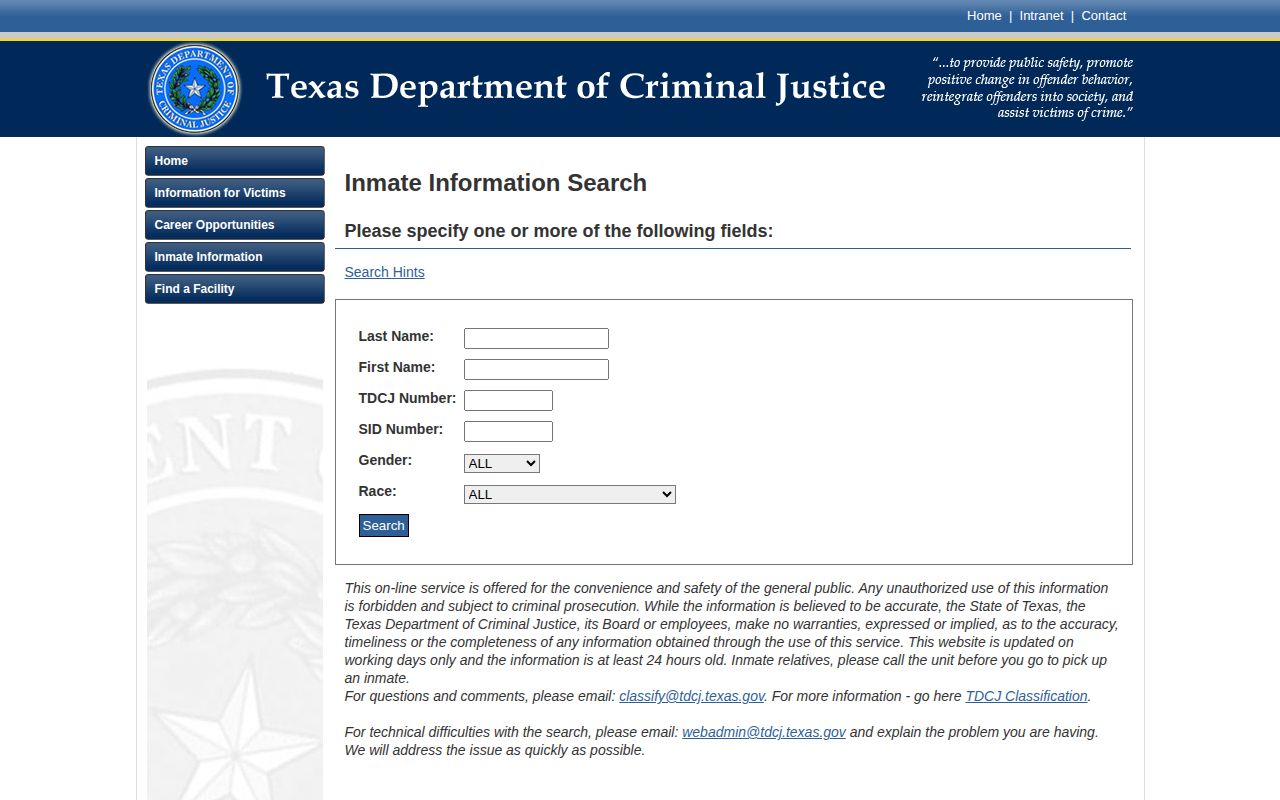
When a state record matches your search, look at the custody state and date. Keep it separate from any local arrest or release record.
Live Oak County Court Dispositions
Felony filings belong to the District Clerk. That office serves as custodian for district-court paperwork. It handles routes for the 36th, 156th, and 343rd District Courts plus the 2nd Multicounty Court at Law. Visit at 301 Houston Street, Room 202, George West, Texas 78022. The phone is 361-449-2733 extension 2. Email is DCOFFICE@loctx.org.
Timing does not always line up as you might expect. A booking can happen before any prosecutor files a case. A warrant can sit on the books with no new booking attached. Court paperwork may also carry a different spelling, cause number, or charge wording than the jail side. For lower-level matters, try the justice of the peace, county, or municipal court. The County Clerk's online search covers public and real-property records, not a criminal docket.
Busted Mugshots by Live Oak City
Two incorporated cities appear on the county map. George West and Three Rivers both have police departments that can help with an incident report. Still, the county Sheriff and Jail stay the main route for booking and custody questions. Neither city posts a daily arrest list or mugshot feed on its official site.
- George West Busted Mugshots: city police incident records, county jail booking route, and court status.
- Three Rivers Busted Mugshots: written city report requests and the county custody fallback.
Countywide news can add useful background around a busted mugshot label. Even so, verify the agency and the location of the incident before treating a city tag as a true local arrest record.